
Reviewed · HISTORIC DISTRICT WALKING TOURS
Self-Guided “The French Quarter Charleston” Solo Walking Tour
A walk you control.
That is the whole point here: a self-guided audio tour through Charleston’s French Quarter that keeps you moving at your pace, from street corners and alleys to the waterfront. You get stories tied to real places, plus the ability to revisit the tour afterward using a virtual replay feature.
I especially like the flexibility. You can pause, walk a bit ahead, and spend extra time where you care most, instead of marching on someone else’s schedule. I also like that the route hits both “big postcard” spots and the smaller lanes that make Charleston feel like Charleston, including Philadelphia Alley and the Pineapple Fountain finish.
One thing to consider: the audio is location-based, so if you drift too far from a stop, playback can get touchy. Also, many places are described from the outside, so if you want a lot of inside access, you’ll need to plan around that.
In This Review
- Key takeaways before you start
- Why a self-guided French Quarter walk works so well
- Price and value: what you pay for in real terms
- Start at 73 N Market St: City Market sets the tone
- From the Powder Magazine entrance: oldest building vibes, no rush
- French Huguenot Church and the idea of persecution far from home
- Dock Street Theater, pirate history, and the corners that feel like stories
- Old Slave Mart Museum: important context from the sidewalk
- Philadelphia Alley and why it is called Duelers Alley
- Waterfront Park, Echo Rock, and the road to the Pineapple Fountain
- Pineapple Fountain: the iconic finish you can build on
- Audio and phone realities: what to expect and how to handle issues
- Walking comfort: short but not friction-free
- Who should book this French Quarter solo tour
- Should you book this self-guided walking tour?
- FAQ
- How long is the French Quarter Charleston solo walking tour?
- Where does the tour start and end?
- Is the tour audio in English?
- Do I get into stops like the Old Slave Mart Museum and Powder Magazine?
- Can I walk through Charleston City Market during the tour?
- What is the price per person?
- Can I replay the tour after I finish?
- Are service animals allowed?
- Is there free cancellation?
Key takeaways before you start
- Pause-and-replay audio: you can stop whenever you want and replay later in virtual mode
- Essential French Quarter anchors: City Market, Old Slave Mart area, waterfront sights
- Alleys with character: Philadelphia Alley and Lodge Alley help you get off the main drag
- Outside-first storytelling: churches, museums, and historic buildings are mainly viewed from the street
- Smart finish point: the route ends at Pineapple Fountain, easy to continue exploring on foot
Why a self-guided French Quarter walk works so well
Charleston is a city where your best moments often happen between the landmarks: the lane you turn into by accident, the view down a narrow passage, the sudden whiff of salt air near the water. This tour is built for that kind of wandering, because it does not force you into a fixed group pace.
For a solo trip, that matters. You can take a breather, step aside for photos, or linger at a spot that clicks for you—without feeling like you are slowing down a busload of people. And because the tour is audio-based, you can keep your eyes up and your hands free for maps, drinks, and snacks.
You also get a clean “starter route.” It is short enough that you can still have time for lunch, a sunset walk, or a different activity later the same day.
Trade one set of cobblestones for another with more Charleston walking tours.
- Historic Charleston Guided Sightseeing Walking Tour★ 5.0 · 6,216 reviews
- Charleston Horse-Drawn Carriage Tour: Explore Historic Charleston★ 5.0 · 3,561 reviews
- Ghosts of Charleston Night-Time Walking Tour with Unitarian Church Graveyard★ 4.5 · 2,835 reviews
Price and value: what you pay for in real terms
At $9.75 per person, this is priced like an easy upgrade to your own exploration—not a premium guide experience. The value is the audio structure: you are buying the route and the stories, not staff-led narration and not timed ticketed entry.
That pricing works especially well if:
- you like learning at your own speed
- you want a first pass at the French Quarter
- you plan to read plaques, peek inside when open, or do more on your own afterward
If you only want a fast hit of highlights with zero phone time, you might still prefer a traditional guided tour. But if you are happy managing your own pace, this is one of the cheaper ways to get a coherent orientation of Charleston’s French Quarter.
Start at 73 N Market St: City Market sets the tone
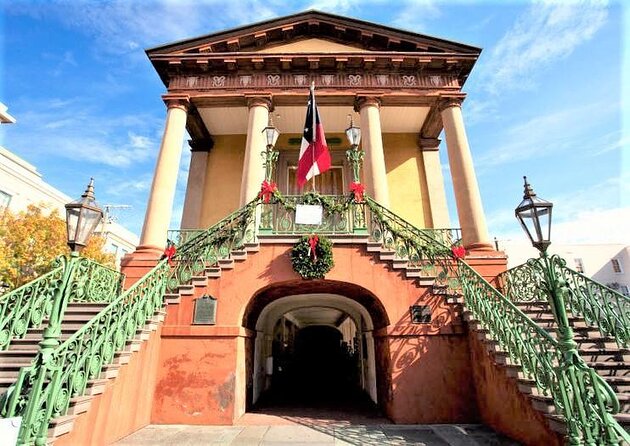
Your walk begins at 73 N Market St, and it is a smart place to start because Charleston City Market is right in the thick of things. The market building dates to 1841, and it was modeled after the Temple of the Wingless Victory in Athens. That detail is a quick hook that makes you look at the architecture instead of just walking past it.
You will also hear the story connected to the confederate museum, with the note that you will not go inside. Even if you are not planning to enter, it helps contextualize what you see around the block.
There is also a practical benefit: if you take the tour between 9:30 a.m. and 5 p.m., you can walk through the Charleston City Market. Since the entry ticket is listed as free during that time window, it is a good chance to grab a bite while you are in the flow.
From the Powder Magazine entrance: oldest building vibes, no rush
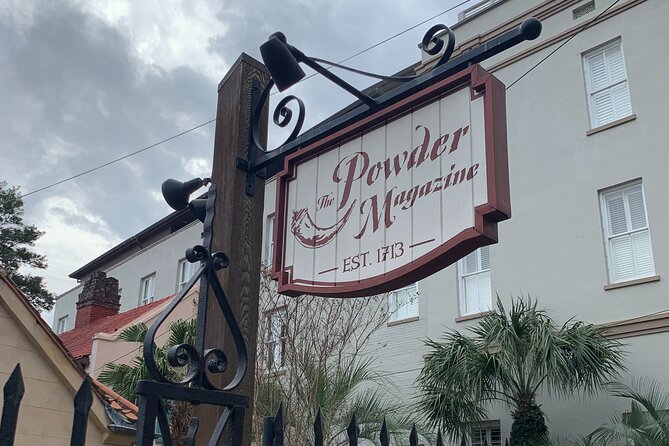
Next you will head toward the Powder Magazine. You do not go in on this tour. Instead, you stop by the entrance and listen to the story of one of Charleston’s oldest buildings.
If you want inside access, the tour note is helpful: you can pause the audio and enter yourself. The admission ticket is listed as not included, so you should expect that to be an extra cost if you choose to go in.
Why I think this stop works even without entry: it keeps the route moving and lets you keep your mental map. Powder Magazine is one of those places where hearing what it was used for changes how you interpret the building the moment you see it.
French Huguenot Church and the idea of persecution far from home
A key emotional turn in this walk comes with the French Huguenot Church stop. You stop by and listen to the story, but the tour does not take you inside.
What you take away matters here: the narration focuses on persecution in France and how the Huguenots fled to the new world. It is a reminder that Charleston’s early story is not only about charm and architecture—it includes survival and displacement.
Even from outside, the stop is worth it if you pay attention to the way the city was shaped by real people arriving under pressure. And because the tour is self-guided, you can slow down if the topic hits you harder than you expected.
Go at your own speed with more Charleston self-guided and audio tours.





Dock Street Theater, pirate history, and the corners that feel like stories
After the church area, the route continues past the Dock Street Theater, which originally opened on February 12, 1736. The tour highlights that it was the first building in America built exclusively for theatrical performances.
That detail is more than trivia. It gives you a sense of how public life and entertainment were part of early Charleston culture, long before modern venues.
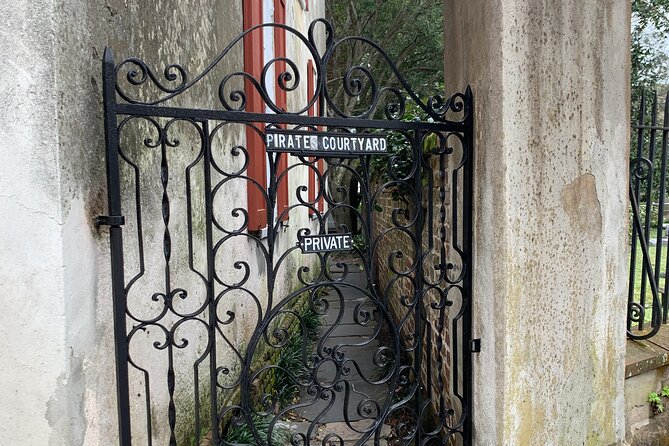
Right after, you will also stop by an old building with a layered past—described as a pirate tavern, later a law firm, and now a gallery. Some say it is haunted. You will experience this one from the outside, but the audio story adds color and makes the block feel like it has a memory.
If you enjoy urban legends, you may have fun with this moment. If you prefer hard facts only, keep it in the category of folklore and mood, not proof.
Old Slave Mart Museum: important context from the sidewalk
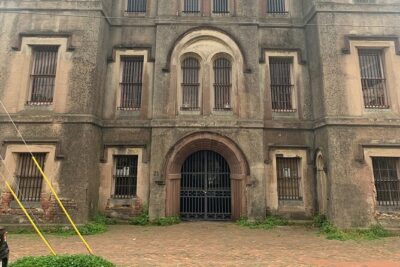
One of the most serious stops on the route is the Old Slave Mart Museum. Charleston’s role in the slave trade is not subtle, and this is one of the places where you cannot afford to tune out.
This tour does not go inside. You stop by the front and hear the story of the building as a slave auction house.
Admission is listed as not included for this stop, so if you want museum entry, you would have to do that separately. Still, even from outside, the audio framing helps you understand why this building matters—and why the history is not just background.
Because the tour is self-paced, you can take a moment here. You do not have to rush to the next stop while you are still processing something heavy.
Philadelphia Alley and why it is called Duelers Alley

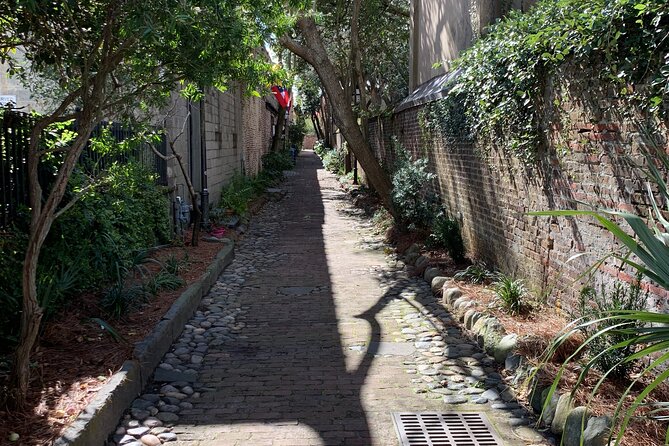
After the more formal historical stops, the tour shifts to atmosphere. You walk through Philadelphia Alley, described as beautiful and off the beaten path.
The story you get here connects to why the alley has the nickname Duelers Alley. It is the kind of detail that turns a simple walking route into a mini history lesson, and it also helps you picture daily life and danger in older Charleston.
You will also pass Lodge Alley, noted as the oldest street in Charleston. Then you move toward Vendue Range and the park area ahead. This sequence matters because it transitions from “stand and look” to “walk and imagine.”
Waterfront Park, Echo Rock, and the road to the Pineapple Fountain
Your route enters Charleston Waterfront Park, where the waterfront went from something people ignored to something locals and visitors flock to. You will see Echo Rock and walk toward the Pineapple Fountain.
Along the way, you will hear the park’s history. This is the part of the walk that often feels like a reward: you are moving away from the densest blocks and getting that open-air sense of Charleston near the water.
Echo Rock is one of those visual stops that works well for quick photos. You can also slow down here because the walk to the fountain is straightforward, and the audio helps keep you oriented without demanding your attention every second.
Pineapple Fountain: the iconic finish you can build on
The tour ends at the Pineapple Fountain, located in the middle of Waterfront Park near the water. The stop is brief, but it covers why pineapples matter to the city’s identity—the tour frames it as part of the story of the Holy City.
Operationally, this is a very practical finish point. Since you end at a landmark that is easy to reach and easy to find on foot, you can immediately keep exploring. From there, you can pivot to more shopping, a museum you want to enter, or just a long stroll along the waterfront.
The fountain is listed as open every day from 12:00 a.m. to 11:30 p.m., which means your end-of-tour timing does not have to be razor sharp.
Audio and phone realities: what to expect and how to handle issues
This is a phone-based self-guided tour, so your success depends on your setup. The experience is designed to work once you have the tour downloaded and ready. Based on feedback, downloading instructions are important—if you try to handle it on the fly while it is hot and you are already outside, you can waste precious minutes.
I’d also plan for location quirks. In at least one case, audio access behaved differently when someone stood about 20 feet away in the shade. Translation: stay near the point on the map when the narration starts, especially for each new stop.
You also have control tools. Multiple people praised the ability to stop and restart at will, and to replay in virtual mode later. That is a big deal if you want to re-listen while you are resting, eating, or even from your hotel room.
One more audio detail to note: some folks reported repeating sound cues (a whistle or similar cue) being a little loud or annoying. If you are sensitive to audio distractions, consider using earbuds or keeping volume moderate.
Walking comfort: short but not friction-free
The tour duration runs about 50 minutes to 1 hour 10 minutes. That is a great length if you want a meaningful orientation without turning your day into an all-day hike.
Still, Charleston sidewalks can be uneven and the streets in this area can be tight. One person flagged uneven surfaces and directions that felt confusing at moments. My practical suggestion: keep a close eye on your phone screen as you transition between stops, not only when you arrive.
Also, because several stops are outside and described from the street, you are not just walking—you are learning while walking. If you like to read signs more than listen, you can always slow down, but be ready to balance audio time and photo time.
Who should book this French Quarter solo tour
This tour is ideal if you want:
- solo flexibility and the ability to pause without feeling rushed
- a structured route through key French Quarter areas
- audio storytelling that you can replay later
It also fits families who want to move at a kid-friendly pace, since you can linger longer at the sites that interest you.
Where I would hesitate: if you strongly prefer a fully guided experience where every major location is entered with a guide’s narration, this may feel lighter than a ticketed tour with inside access. Since several key stops are outside, you’ll get the stories, but you may still want additional museum time on your own.
Should you book this self-guided walking tour?
I think you should book it if you want a smart, low-cost way to learn the French Quarter while still steering your own walking schedule. For $9.75, you get a tight route, a clear finish at Pineapple Fountain, and the ability to pause and replay—perfect for a first Charleston visit or for revisiting on a calmer day.
Skip it or pair it with something else if you want heavy inside access at every stop or you know you struggle with phone-based audio and downloading on the road. In that case, a traditional guided tour might save you time and stress.
If you do book it, give yourself one advantage: download the tour before you start walking, then keep your phone handy and near the stop points when the narration shifts. Do that, and you’ll turn a simple walk into a day with context.
FAQ
How long is the French Quarter Charleston solo walking tour?
The tour takes about 50 minutes to 1 hour 10 minutes.
Where does the tour start and end?
It starts at 73 N Market St, Charleston, SC 29401, and ends at Pineapple Fountain in Waterfront Park at 1 Vendue Range, Charleston, SC 29401.
Is the tour audio in English?
Yes, the tour is offered in English.
Do I get into stops like the Old Slave Mart Museum and Powder Magazine?
Most stops are from the outside. The Powder Magazine and Old Slave Mart Museum stops are described outside, and the tour does not include entry. You may be able to pause and enter where noted, but admissions are not included where listed.
Can I walk through Charleston City Market during the tour?
If you take the tour between 9:30 a.m. and 5 p.m., you can walk through Charleston City Market. Entry is listed as free for that part.
What is the price per person?
The price is $9.75 per person.
Can I replay the tour after I finish?
Yes. The tour includes a virtual replay feature you can use after your first tour.
Are service animals allowed?
Yes, service animals are allowed.
Is there free cancellation?
Free cancellation is available. You can cancel up to 24 hours in advance for a full refund.
More Rainbow Row & Battery Walks in Charleston






More Self-Guided & Audio Tours in Charleston






More Historic District Walking Tours in Charleston





Still deciding? Here are the newest Charleston tours and experiences we have reviewed











Historic District Walking Tours, compared.
 ★ 5.0Historic Charleston Guided Sightseeing Walking TourFrom $306,216 reviews
 ★ 5.0Charleston Horse-Drawn Carriage Tour: Explore Historic CharlestonFrom $493,561 reviews
 ★ 4.5Ghosts of Charleston Night-Time Walking Tour with Unitarian Church GraveyardFrom $352,835 reviews
 ★ 5.0Hidden Alleyways and Historic Sites Small-Group Walking TourFrom $342,335 reviews
 ★ 5.0Highlights of Charleston Guided Walking Tour2,206 reviews
 ★ 5.0Charleston Haunted Booze and Boos Ghost Walking TourFrom $391,569 reviews
 ★ 5.0Charleston’s Pleasing Terrors Night-Time Walking Ghost TourFrom $291,345 reviews
 ★ 5.0Charleston historical walking tour with a Professor of History at The CitadelFrom $401,284 reviews
Browse the lists this tour appears in