
Reviewed · HISTORIC DISTRICT WALKING TOURS
Revolutionary Charleston Walks – History Walking Tour
History has a way of sticking to your shoes. This 2-hour Charleston walk turns major downtown sights into a story you can actually remember, from Rainbow Row photo spots to harbor views of Fort Sumter. I like that it’s not just standing and staring. You get context, and the pace is built for asking questions.
What I like most is the guide style. Some guides in this program, including Paul and Ben, are known for keeping things conversational, not lecture-y, and for adding details like native plants and trees when the route calls for it. You’ll also get the kind of stop-by-stop connections that help even a non–history person go, okay, I get it.
One thing to consider: several stops are view-only. You’ll look from the sea wall for Fort Sumter and you’ll walk past places like Ryan’s Mart’s remains and the Circular Congregational Church rather than going inside. If you’re hoping for hands-on touring of buildings, this is more of a street-level history lesson.
In This Review
- Key things that make this Charleston walk work
- A 2-hour hit of downtown Charleston history
- Starting at Washington Square (and why timing matters)
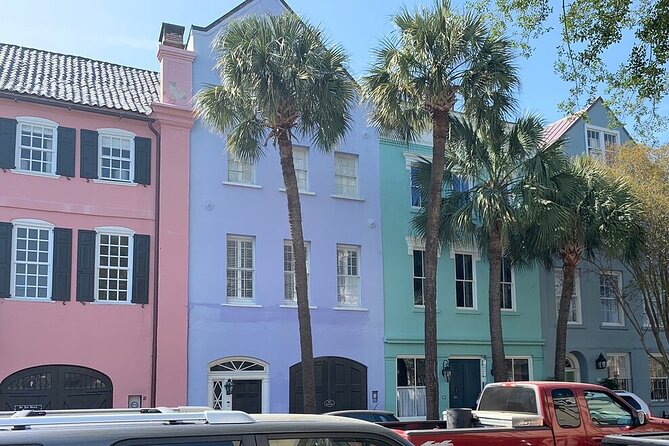
- Rainbow Row: the pastel icons with real backstory
- Charleston City Market: shopping energy with historic gravity
- Fort Sumter from the seawall: the view without the ferry plan
- Ryan’s Mart: learning the hard parts without entering the site
- Circular Congregational Church: the religion thread you’ll notice after
- Battery & White Point Gardens: harbor views and the Civil War shift
- Price and value: why $36 feels fair for what you get
- What to bring (so the walk stays fun)
- Who should book Revolutionary Charleston Walks
- Should you book this 2-hour history walk?
- FAQ
- How long is the Revolution Charleston Walk?
- Where is the meeting point, and where does it end?
- What’s included in the price?
- Are the stops ticketed?
- What should I bring?
- Can I cancel for free?
Key things that make this Charleston walk work
- A small group (max 20) means fewer lost questions and more time to ask what you’re curious about
- Free entry at the stops keeps the cost focused on the guide and the experience
- Fort Sumter viewpoints without the ferry save time while still giving you the big-picture setting
- Hard history included through stories tied to Ryan’s Mart, even though you don’t enter buildings
- Downtown route logic: Battery views, market energy, and iconic homes in one smooth flow
- Bring-your-questions vibe: the best moments tend to come from dialogue, not speeches
A 2-hour hit of downtown Charleston history
This tour is built for people who want real context, but don’t want to spend an entire day “touring.” In about two hours, you cover a tight loop through some of the most recognizable parts of downtown Charleston, while the guide links each location to the bigger story of the city.
The sweet spot here is that you don’t just get the postcard version of Charleston. You get the city’s turning points, including fires that changed the urban landscape and the role of religion in everyday life. It’s the kind of tour where you start watching the details in the buildings and the streets around you, not just taking pictures.
I also like that the group stays small enough that the guide can adapt. When you ask something, it’s more likely to get an actual answer rather than a quick summary while everyone shuffles along.
You’ll finish back at the same starting area, which is handy. You can then go grab lunch or keep wandering without the stress of figuring out where you’ve ended up.
Trade one set of cobblestones for another with more Charleston walking tours.
- Historic Charleston Guided Sightseeing Walking Tour★ 5.0 · 6,216 reviews
- Charleston Horse-Drawn Carriage Tour: Explore Historic Charleston★ 5.0 · 3,561 reviews
- Ghosts of Charleston Night-Time Walking Tour with Unitarian Church Graveyard★ 4.5 · 2,835 reviews
Starting at Washington Square (and why timing matters)
You meet at Washington Square, 80 Broad St and the tour starts at 11:00 am. That timing matters in Charleston. Midday light makes the colors of Rainbow Row pop, and the air is usually at its most active before the afternoon slows down.
You’ll also be close to public transit, which helps if you’re mixing this with other plans. And the tour uses a mobile ticket, so you won’t be digging through email or paperwork while you’re trying to keep your day moving.
The walk ends back at the meeting point. I like that kind of closure. You don’t have to recalibrate your plans. You can tack on a museum visit, a market snack run, or a slow stroll toward the waterfront while your brain is still full of what you just learned.
One practical note: this is on foot. The tour is designed for most travelers, and the group max is 20, but you still need comfortable shoes because you’ll be walking between sights.
Rainbow Row: the pastel icons with real backstory
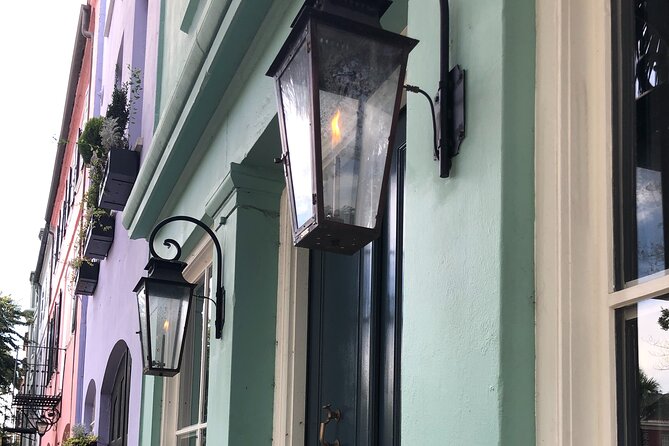
Rainbow Row is the stop everyone recognizes. It’s that row of pastel-colored historic homes along East Bay Street, right near the Battery. Even if you’ve seen it in photos, it feels different up close, because you notice how the street life wraps around the buildings.
What makes this stop worth doing with a guide is the way the story connects the architecture to the city’s evolution. Charleston’s homes can look sweet and gentle from a distance. Up close, you see how much history is tied to where people lived, how the city rebuilt after disasters, and how the neighborhood stayed part of daily life.
There’s also a practical side: this is a popular photo area. You’ll see couples doing engagement and wedding style shots while other visitors hunt for the angle with no one in the frame. If you care about photos, the guide’s route helps you time your looking and keep moving instead of getting stuck in the same spot for 20 minutes.
Admission here is free, so your money stays on what you came for: interpretation. You’re not paying to enter anything; you’re paying for the meaning behind what you’re seeing.
Charleston City Market: shopping energy with historic gravity

Next up is the Charleston City Market, one of the nation’s oldest and largest public markets. It stretches across four city blocks, and it’s home to more than 300 daily vendors. In other words: this is where you feel the city’s everyday heartbeat.
Here’s what a guided stop can add: a market isn’t just where you buy things. It’s where people traded goods, heard news, and built social networks. You’ll get that context as you walk through the market area, so it stops being random stall-to-stall browsing and starts feeling like a continuation of a long-running system.
If you’re trying to plan your day, this stop also makes timing easier. The market is lively, but it’s also easy to dip into snacks and souvenirs without losing your place in the tour for long. And because the market admission is free, you can treat it as a cultural stop even if you don’t plan to buy much.
If you do want to buy things, do it calmly. Markets like this tempt you to sprint. I suggest you first walk the full area, then go back with a clearer idea of what you actually want.
Fort Sumter from the seawall: the view without the ferry plan
The tour includes a Fort Sumter National Monument viewing, but with an important twist: you’ll look from the sea wall and you won’t actually enter the fort. Fort Sumter sits in the middle of Charleston Harbor, so this approach keeps your time efficient.
Still, this is a high-value stop because it gives you the geography of the Civil War era and earlier conflict. Fort Sumter began as a sea fort built on an artificial island meant to protect Charleston from naval invasion. You’ll also get the timeline context tied to the War of 1812, and then to 1861, when the Battle of Fort Sumter marked the start of the American Civil War.
Why that matters for your experience: when you can see the harbor, it’s easier to understand why this location carried so much weight. From shore, the fort isn’t just a distant structure. It’s part of the city’s defense system and its political story.
The free admission part is also meaningful. You’re not adding extra ticket costs to get the core sight. You’re paying for the guide to connect the view to history instead of letting you stare at a landmark with no framework.
Dig deeper into the past with more Charleston history tours.




Ryan’s Mart: learning the hard parts without entering the site
This is the stop that adds the emotional weight. The tour includes a look at what was once part of Ryan’s Mart, a complex that included a brick wall enclosed yard, a four-story building, and key areas tied to slavery’s brutal systems.
The tour focuses on stories connected to a barracoon, sometimes described as a slave jail, plus a kitchen and a morgue. You won’t enter the buildings, but you’ll be close enough to understand the site as more than an abstract fact. You’ll hear the story in a way that helps the location feel real.
For many visitors, this is the moment the tour becomes more than sightseeing. It’s not comfortable, and it shouldn’t be. But it’s valuable because it prevents the city’s past from becoming a set of pretty facades with no consequences.
If you prefer gentle, purely light-hearted tours, this part may feel intense. On the other hand, if you want Charleston in full—beauty and the harm in the same story—this is exactly the balance you’re looking for.
Circular Congregational Church: the religion thread you’ll notice after
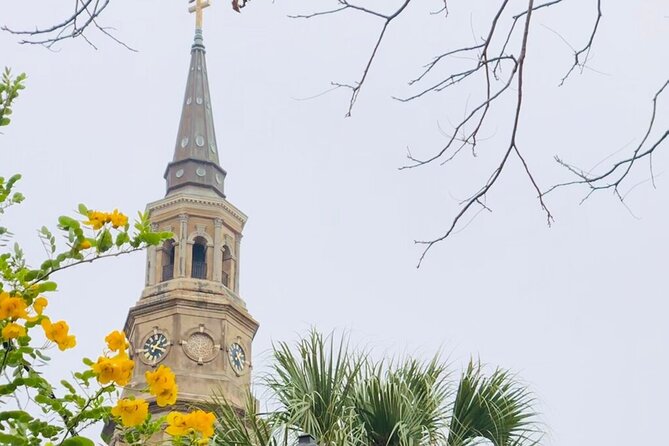
You’ll also walk past the Circular Congregational Church of Charleston. It was founded in 1681, and it’s one of the oldest continuously worshipping congregations in the South. You won’t go inside, but you’ll still get a sense of why this kind of institution mattered in a city shaped by community and survival.
This stop works because it adds texture. Charleston history isn’t only war and economics. It’s also daily life, norms, and how people built meaning in real time.
Walking past rather than entering is also a practical choice. You keep momentum through the route instead of losing time to a more formal visit schedule. The trade-off is simple: you get context, not a guided interior look.
If you’re the kind of traveler who enjoys seeing how institutions influence a city’s character, you’ll probably enjoy this quiet, exterior-focused moment.
Battery & White Point Gardens: harbor views and the Civil War shift
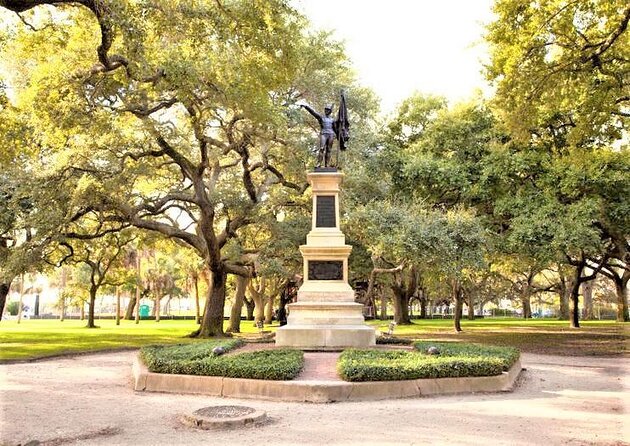
The tour ends with Battery & White Point Gardens, a landmark area that gives you some of Charleston’s most cinematic sightlines. This is where you get views of Fort Sumter and Charleston Harbor, with the Ashley and Cooper rivers emptying into the Atlantic.
The gardens were first used as a public garden in 1837. Then the Civil War changed how the space functioned. The Battery area became fortification for the city—so the same open, scenic place also carried military purpose.
This “before and after” shift is why this stop lands. You can stand in a place that feels like a vacation postcard and still understand that it once had a defensive role. The guide’s job here is to show you how the city repurposed space when it needed to.
Admission is free, and the value comes from understanding what you’re looking at. If you like panoramic views, you’ll also appreciate that this is close to where you’ve been walking all morning, so it feels like a final reveal rather than a random stop on a long itinerary.
Price and value: why $36 feels fair for what you get
At $36 per person for about two hours, this tour sits in a range that can feel either overpriced or like a deal, depending on what you’re comparing it to. Here’s the practical way to judge it.
First: the major stops are free to view. That means your money isn’t funding entrance fees. You’re paying for a guide to connect the sites to the stories that make them matter.
Second: you’re getting a guided route through multiple famous locations without needing to plot your own path, manage transfers, and still figure out what to notice. You might do a self-guided walk and hit the big names. But the value of this tour is that you don’t have to guess at what’s important. The guide points you toward the details that turn “I saw a building” into “I understand why it mattered.”
Third: the small group size helps. When the group is 20 max, the experience tends to feel less like a conveyor belt and more like a shared walk.
If you’re a first-time Charleston visitor, I think this price is easy to justify. If you’re a deep history person, it’s still a good intro because it organizes the city’s major themes into one coherent morning walk.
What to bring (so the walk stays fun)
This tour is outdoors and it’s a real walking day. Bring comfortable shoes—not fancy ones, the kind you can keep on without regret.
Also plan for the basics Charleston always offers:
- Water (not provided)
- Bug spray
- Sunscreen
If it’s a warm day, you’ll feel the pace by the time you hit the Battery/White Point Gardens portion. It’s not a marathon, but it’s not a sit-down tour either. The guide keeps you moving through the main stops, so you want your body to cooperate.
One more small tip: since some sites are view-only and others are walk-past, you’ll have better photos and better listening if you don’t spend too much time hovering at the first angle you see.
Who should book Revolutionary Charleston Walks
I’d book this tour if you want:
- A short, focused morning plan
- Major downtown stops without paying for separate entries
- A guide who encourages questions and keeps the mood conversational
- A route that includes the difficult parts of Charleston’s story, not just the pretty bits
I might skip it if you only want indoor museum-style visits, because several key stops are outside, and Fort Sumter is a seawall viewpoint rather than an onboard experience.
But if you’re like most people, you want the best of Charleston with less hassle. This is a tidy way to get there.
Should you book this 2-hour history walk?
Book it if you’re trying to make your first Charleston trip feel coherent. In two hours, you’ll see the places people come for and you’ll learn enough to understand why those places matter. The best part is the guide energy: conversational storytelling, room for questions, and details that make you look closer at what you would otherwise skim.
Don’t book it if you need a lot of inside access or a more hands-on tour of buildings. This one is about learning from the street, the views, and the site context.
If you’re ready for a morning walk that turns landmarks into meaning, this is a smart use of time—and for $36, the free access to the sights makes it feel even more reasonable.
FAQ
How long is the Revolution Charleston Walk?
The tour runs for about 2 hours.
Where is the meeting point, and where does it end?
You meet at Washington Square, 80 Broad St, Charleston, SC 29401 and the tour ends back at the meeting point.
What’s included in the price?
The included highlight is amazing stories of Charleston. The tour also operates with a mobile ticket and is offered in English.
Are the stops ticketed?
The information provided lists admission as free for the stops on the route, and the tour includes viewing Fort Sumter from the sea wall without entering the fort.
What should I bring?
Bring water, comfortable shoes, bug spray, and sunscreen. Bottled water is not included.
Can I cancel for free?
Yes. You can cancel for a full refund up to 24 hours before the experience start time. Within 24 hours, the amount is not refunded.
More Tours Across Charleston






More Charleston Tours Worth Booking
More Historic District Walking Tours in Charleston



Still deciding? Here are the newest Charleston tours and experiences we have reviewed












Historic District Walking Tours, compared.
 ★ 5.0Historic Charleston Guided Sightseeing Walking TourFrom $306,216 reviews
 ★ 5.0Charleston Horse-Drawn Carriage Tour: Explore Historic CharlestonFrom $493,561 reviews
 ★ 4.5Ghosts of Charleston Night-Time Walking Tour with Unitarian Church GraveyardFrom $352,835 reviews
 ★ 5.0Hidden Alleyways and Historic Sites Small-Group Walking TourFrom $342,335 reviews
 ★ 5.0Highlights of Charleston Guided Walking Tour2,206 reviews
 ★ 5.0Charleston Haunted Booze and Boos Ghost Walking TourFrom $391,569 reviews
 ★ 5.0Charleston’s Pleasing Terrors Night-Time Walking Ghost TourFrom $291,345 reviews
 ★ 5.0Charleston historical walking tour with a Professor of History at The CitadelFrom $401,284 reviews
Browse the lists this tour appears in