
Reviewed · HISTORIC DISTRICT WALKING TOURS
Historic Charleston Walking & Storytelling Tour
Charleston’s past walks right beside you. This 2-hour story-led stroll through key landmarks turns names on buildings into real scenes, with a guide who can adjust the talk to your level. I especially liked the mix of Revolutionary-era storytelling and architecture facts that actually help you see the city.
I also love the practical payoff: you get included admissions to special sites (Philip Simmons House and Halsey Gallery), plus standout outdoor views from White Point Garden. One thing to consider is that it’s a compact route—two hours means steady walking, so comfortable shoes and sun protection matter.
In This Review
- Key Points at a Glance
- What $35.90 Buys You in Downtown Charleston
- Meeting on East Bay Street (122 E Bay St) and What the Pace Feels Like
- Old Exchange and Provost Dungeon (Built 1771): Trade, Power, and a Revolutionary Lens
- Rainbow Row (79 to 107 East Bay St): Pastel Colors With a Real Reason
- The Fort Mechanic Foundations and Charles Edmondston’s House: Engineering Underfoot
- White Point Garden and the Battery: Views With Defensive History
- Nathaniel Russell House (Built 1808): Neoclassical Beauty With Real Consequences
- The Four Corners of Law at Meeting and Broad: Four Buildings, One Power Junction
- Included Admissions: Philip Simmons House and Halsey Gallery
- Who This Tour Fits Best (and Who Might Want a Different Plan)
- Should You Book? My Practical Take
- FAQ
- What is the price per person?
- How long does the tour last?
- Where is the meeting point?
- What language is the tour offered in?
- Do I need a physical ticket?
- Is admission included for any sites?
- What are the main stops on the route?
- How many people are on the tour?
- Are service animals allowed and what happens if weather is bad?
Key Points at a Glance
- A tight 2-hour route that hits big Charleston symbols without turning into an all-day project
- Revolution + colonial stories tied to places like the Old Exchange and Provost Dungeon
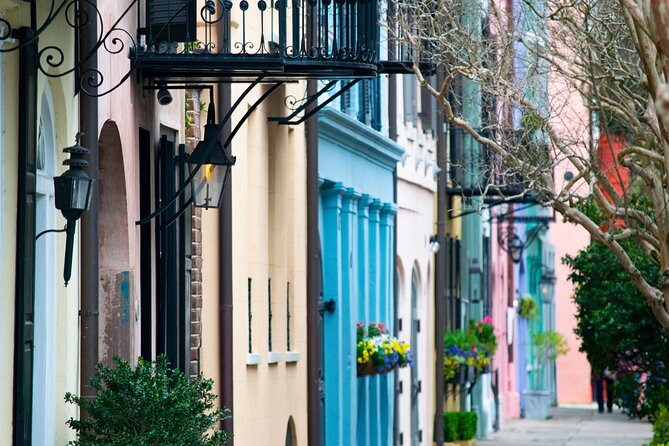
- Rainbow Row context beyond photos, including why the houses became pastel again
- Harbor-side viewpoints from White Point Garden and the Battery promenade
- Real-house access included: admission to Philip Simmons House and Halsey Gallery
- Small group size with a maximum of 20 travelers
What $35.90 Buys You in Downtown Charleston
At $35.90 per person for about two hours, this tour lands in the “worth it if you like history with a human voice” category. You’re not just paying for walking—you’re paying for storytelling that connects buildings to events, plus admission to specific indoor stops.
The other value piece is what you avoid: guesswork. Charleston can look like one pretty street after another. This format helps you attach meaning fast—why the city’s layout matters, what old trade and government buildings were built to do, and how later Charleston single houses and Neoclassical mansions reflect wealth and power.
Also, the included admissions (Philip Simmons House and Halsey Gallery) are a big deal. Instead of treating those sites as separate purchases later, they’re part of the flow. That makes the cost feel less like a “walking lecture fee” and more like an organized way to sample several meaningful stops in one block of time.
Trade one set of cobblestones for another with more Charleston walking tours.
- Historic Charleston Guided Sightseeing Walking Tour★ 5.0 · 6,216 reviews
- Charleston Horse-Drawn Carriage Tour: Explore Historic Charleston★ 5.0 · 3,561 reviews
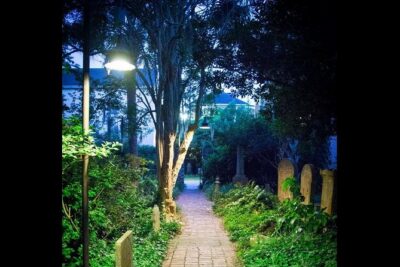
- Ghosts of Charleston Night-Time Walking Tour with Unitarian Church Graveyard★ 4.5 · 2,835 reviews
Meeting on East Bay Street (122 E Bay St) and What the Pace Feels Like
The tour starts at 122 E Bay St, Charleston, SC 29401, and ends back at the meeting point. You’ll use a mobile ticket, and the tour is offered in English.
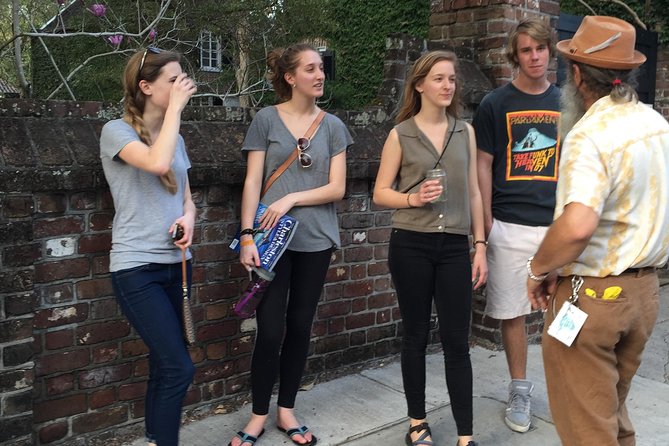
With a maximum of 20 travelers, it stays small enough for a lively back-and-forth—especially if you like asking questions. Based on how the tour is described, your guide (often Larry) works like a good storyteller: he can tailor the talk to your curiosity and background, so you’re not stuck with the exact same script no matter who’s on the sidewalk.
Two hours sounds short until you do it in historic downtown. You’ll want to show up ready to walk. Bring sunscreen, a hat, and water if you’re going in warmer months; the route includes outdoor sections with sun exposure.
Old Exchange and Provost Dungeon (Built 1771): Trade, Power, and a Revolutionary Lens
Your first major stop is the Old Exchange and Provost Dungeon, built in 1771 as a commercial exchange and custom house. Today, it’s a non-profit historic site focused on the American Revolution and colonial Charleston.
This is the kind of building that explains why Charleston mattered. Customs and commerce weren’t background noise—they were the engine room. From there, the story naturally shifts toward conflict and control, since “provost dungeon” is basically a loud clue that this was also where authorities held people.
Why I like this start: it gives you a foundation fast. Once you understand that this city ran on trade and government power, later landmarks stop being random. They become clues.
Possible drawback: if you prefer light and airy sightseeing, the themes connected to a dungeon may feel heavier than, say, a garden-only stop. Still, it’s exactly the sort of location that makes Charleston history feel grounded instead of postcard-only.
Rainbow Row (79 to 107 East Bay St): Pastel Colors With a Real Reason
Then it’s on to Rainbow Row, the line of thirteen colorful historic houses on East Bay Street, north of Tradd St. and south of Elliott St. This is the longest cluster of Georgian row houses in the United States, and the name Rainbow Row came from the pastel colors used after restorations in the 1930s and 1940s.
What makes this stop more than a photo break is the restoration story. You’re not just seeing “pretty houses.” You’re seeing how Charleston chose to preserve a look that reflects its 18th-century design style—then later decided how those colors should be remembered.
Practical tip: if you care about architecture, pay attention to how row housing creates rhythm along a street. It’s one of the easiest ways to understand urban planning at a walkable scale.
The Fort Mechanic Foundations and Charles Edmondston’s House: Engineering Underfoot
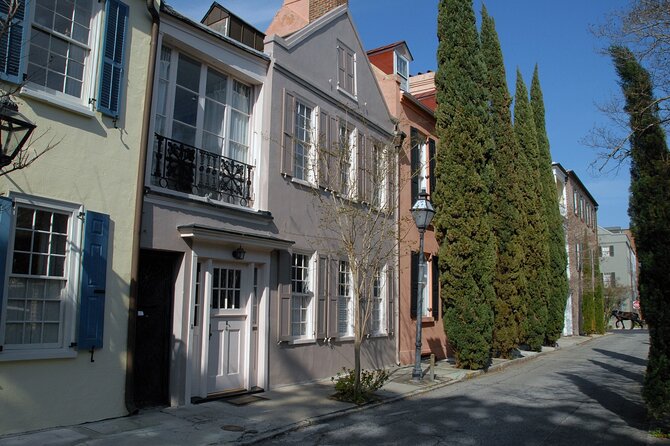
Next, you’ll walk through the layers of time behind a standout home. One key detail: the house sits on foundation ruins of Fort Mechanic, which was on that site in the later 18th century. Then the story shifts to Charles Edmondston, a Scottish immigrant from the Shetland Islands, who bought the low sandy lot in 1817.
Here’s where the real-world problem-solving comes in. The land was unstable and soggy, so city officials built a sea wall in 1820 before construction could proceed. Edmondston then started the house, with the antebellum modified Charleston single house (side-hall) built between 1820 and 1828, originally in an English Regency architectural style.
If you like when a tour teaches you to “read” the ground, this is a strong stop. You see how geography and engineering shaped what could be built—long before modern buildings use the same basic idea with different tools.
You also get a jaw-dropping sense of scale here: the house is described as having 24,000 square feet, with thirty main rooms and additional smaller spaces. The main hall is 50 feet long, and the ballroom has a 45-foot-high ceiling. That ceiling height is the kind of fact that changes how you picture daily life in a grand house.
Dig deeper into the past with more Charleston history tours.


White Point Garden and the Battery: Views With Defensive History
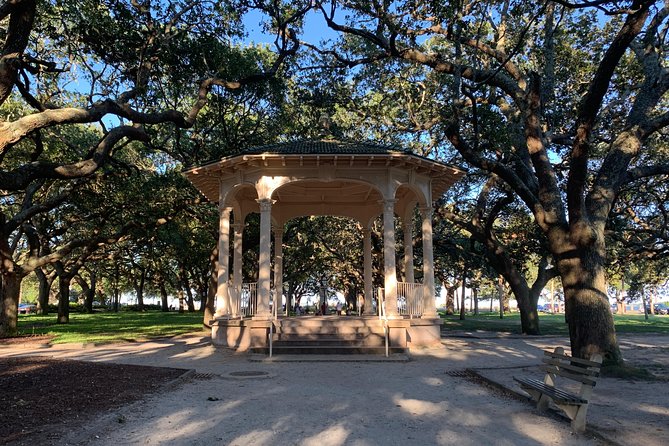
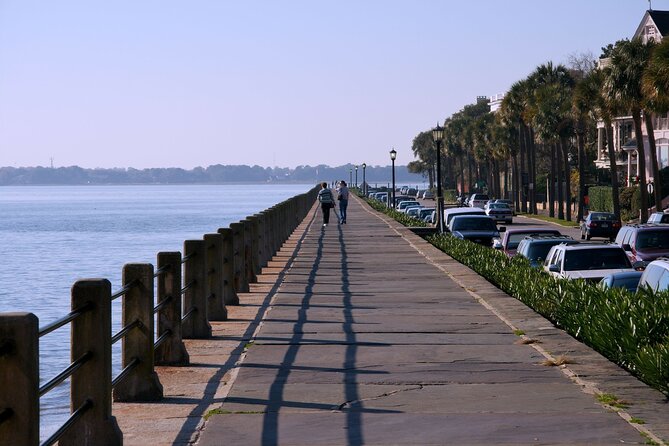
After the indoor grandeur, you step into an outdoor perspective: White Point Garden, a 5.7-acre public park at the tip of the Charleston peninsula. It sits at the southern terminus of the Battery, which is both a defensive seawall and a promenade.
This stop pays off visually. It’s a place where you can connect the city’s built elegance with its practical need for protection. The tour frames the harbor views as part of the city’s logic: where you can see matters, especially when the sea is also a vulnerability.
The garden is defined by clear boundaries—East Battery, Murray Blvd., King St., and South Battery—so you’ll know exactly where you are in the city’s geometry. That helps a lot if you’re trying to orient yourself as you move through Charleston.
Possible drawback: it can be a sun-heavy section depending on the time of year. Plan for it. If it’s warm, bring water and use shade when you can.
Nathaniel Russell House (Built 1808): Neoclassical Beauty With Real Consequences
Next up is the Nathaniel Russell House at 51 Meeting Street, built in 1808 by Nathaniel Russell, described here as a slave trader and wealthy merchant. Architecturally, it’s recognized as one of America’s most important Neoclassical houses and was designated a National Historic Landmark in 1973.
I appreciate that this stop doesn’t sanitize the story. The architecture is impressive, but the tour’s framing acknowledges the human cost connected to wealth. That balance matters. You get to understand why something was built, not just how it looks.
If you’re the kind of traveler who wants history to feel honest, this is a strong match. If you’re traveling with younger kids, you might want to be ready for the topic to come up directly, since the builder’s background is part of the core description.
The Four Corners of Law at Meeting and Broad: Four Buildings, One Power Junction
One of the most interesting parts of the tour happens at Meeting and Broad Streets, known as the Four Corners of Law. The term was coined in the 1930s by Robert Ripley (creator of Ripley’s Believe it or Not!).
You’re not just told the phrase—you’re shown the institutions stacked around that intersection:
- St. Michael’s Anglican Church, constructed between 1752 and 1761, at the southeast corner
- Charleston City Hall in an Adamesque style, built between 1800 and 1804, at the northeast corner
- Charleston County Courthouse, originally constructed in 1753 as the provincial capital, rebuilt in 1792, at the northwest corner
- United States Post Office and Federal Courthouse, built in 1896, at the southwest corner
This is one of those stops that makes you think differently about city design. It’s a reminder that law, religion, government administration, and the federal presence all lived side-by-side—right where people walked every day.
It’s also a helpful “map moment.” After seeing these four corners, you’ll find you can better visualize where civic authority sits in Charleston’s street plan.
Included Admissions: Philip Simmons House and Halsey Gallery
A key highlight is that admission to the Philip Simmons House and Halsey Gallery is included. That means you’re getting more than just street stops and exterior viewing.
If you’re planning your Charleston time tightly, this is smart. You’re adding two specific cultural/historic experiences without needing to plan separate tickets on top of everything else.
I’d treat these included stops as the “slow down and look closely” part of the day. Houses and galleries are where a guide’s explanation can land hardest, because you’re not just glancing—you’re actually inside the space where art and memory do their work.
Who This Tour Fits Best (and Who Might Want a Different Plan)
This tour is a great choice if you want a guided, story-forward way to see major Charleston sites in a short window. It’s especially suited to people who enjoy:
- architecture details tied to real events
- American Revolution themes and colonial-era context
- a route that includes both street scenes and indoor viewing
Because the group is capped at 20, it also works well for couples and families who want interaction without getting lost in a crowd.
One type of traveler who might hesitate: someone who hates any historical content connected to slavery and coercion. Since the Nathaniel Russell House description includes the builder’s role as a slave trader, this tour is not a “polite history only” style. If that’s a concern, it’s still worth considering—but you should go in knowing the subjects will be part of the conversation.
Should You Book? My Practical Take
If your goal is to make Charleston feel understandable in a couple of hours, I think this is a strong book. The route hits recognizable anchors—Old Exchange and Provost Dungeon, Rainbow Row, the Nathaniel Russell House, White Point Garden, and the Four Corners of Law—and ties them to stories that help you connect the dots.
I’d book it if you:
- like tours with a guide who can shape the talk to your interests (Larry is known for that kind of approach)
- want a compact plan with included admissions
- are ready to walk steadily and enjoy both views and interiors
FAQ
What is the price per person?
It costs $35.90 per person.
How long does the tour last?
The tour is about 2 hours.
Where is the meeting point?
The tour starts at 122 E Bay St, Charleston, SC 29401, USA.
What language is the tour offered in?
The tour is offered in English.
Do I need a physical ticket?
No. It uses a mobile ticket.
Is admission included for any sites?
Yes. Admission to the Philip Simmons House and Halsey Gallery is included.
What are the main stops on the route?
You’ll visit places that include the Old Exchange and Provost Dungeon, Rainbow Row, White Point Garden, the Nathaniel Russell House, and the Four Corners of Law around Meeting and Broad Streets.
How many people are on the tour?
There is a maximum of 20 travelers.
Are service animals allowed and what happens if weather is bad?
Service animals are allowed. The tour requires good weather, and if it’s canceled due to poor weather you’ll be offered a different date or a full refund. Free cancellation is available up to 24 hours in advance for a full refund.
More Tours Across Charleston




More Charleston Tours Worth Booking
More Historic District Walking Tours in Charleston
Still deciding? Here are the newest Charleston tours and experiences we have reviewed








Historic District Walking Tours, compared.
 ★ 5.0Historic Charleston Guided Sightseeing Walking TourFrom $306,216 reviews
 ★ 5.0Charleston Horse-Drawn Carriage Tour: Explore Historic CharlestonFrom $493,561 reviews
 ★ 4.5Ghosts of Charleston Night-Time Walking Tour with Unitarian Church GraveyardFrom $352,835 reviews
 ★ 5.0Hidden Alleyways and Historic Sites Small-Group Walking TourFrom $342,335 reviews
 ★ 5.0Highlights of Charleston Guided Walking Tour2,206 reviews
 ★ 5.0Charleston Haunted Booze and Boos Ghost Walking TourFrom $391,569 reviews
 ★ 5.0Charleston’s Pleasing Terrors Night-Time Walking Ghost TourFrom $291,345 reviews
 ★ 5.0Charleston historical walking tour with a Professor of History at The CitadelFrom $401,284 reviews
Browse the lists this tour appears in