
Reviewed · HISTORIC DISTRICT WALKING TOURS
Charleston Self-Guided Audio Walking Tour
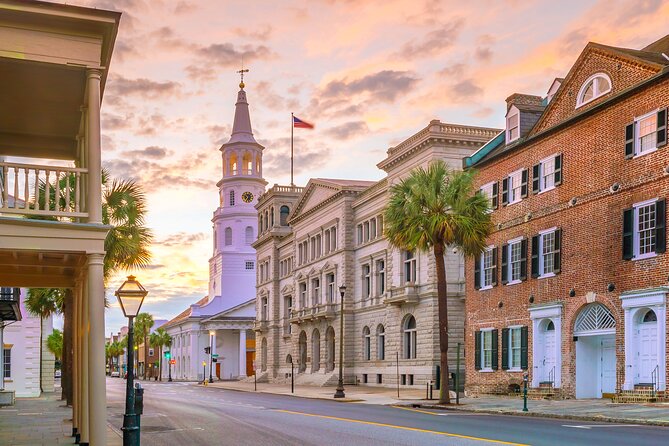
Your phone turns Charleston into a storybook. This self-guided audio walking tour uses GPS so the narration cues as you get near key landmarks, including major photo stops and famous streets.
I like that it works on offline maps after you download, so you’re not stuck hunting for service while walking. You also get hands-free audio that plays as you go, which keeps the walk relaxed.
I especially like the amount of storytelling packed into a doable loop. Expect 45+ audio stories, a pace you can control, and the ability to stop for museums, snacks, and photos whenever you want.
Best of all, it’s lifetime access with no expiry, so you can use it again on a future trip instead of treating it like a one-time ticket.
One consideration: the experience depends on staying near the route and keeping your phone awake for GPS cues. If your signal drops during download, or you wander off-track, you may hit awkward gaps where the audio doesn’t trigger right away.
In This Review
- Key Highlights You’ll Actually Feel on the Walk
- Price and Value: Why $14.99 Can Be a Smart Way to See Charleston
- Offline GPS Setup: The App Experience That Makes or Breaks Your Day
- Starting Point and Route: From 152 Market St to the City Market Finish
- Stop 1: Circular Congregational Church and the White Meeting House Story
- Stop 2 to 3: Hibernian Hall and the South Carolina Historical Society Museum
- Four Corners of Law and South Carolina Society Hall: Power at Broad and Meeting
- John Robert Pringle House and the Patrick O’Donnell House Detail You’ll Remember
- White Point Garden, Civil War Strategy, and the William Moultrie Memorial
- The Palmer Home and Edmondston-Alston House: Two More Windows Into Downtown Life
- Longitude Lane and Rainbow Row: Postcard Views With a Useful Story Behind Them
- Slave Auction Site Memorial and Old Slave Mart Museum: Don’t Skip These Stops
- Dock Street Theater, St. Philip’s Church, and the Bent Street Detail
- Charleston City Market Finish: Food, Crafts, and Gullah Sweetgrass Baskets
- One More Thing the Tour Carries: Old Charleston Jail and a Founding Father Connection
- Who Should Book This Charleston Self-Guided Audio Walking Tour
- Should You Book It? My Straight Answer
- FAQ
- How long is the Charleston self-guided audio walking tour?
- Where do I start and end the tour?
- Do I need cellular service during the tour?
- What language is the narration in?
- Does the audio play automatically based on location?
- Is the tour available for future trips?
- Are admission tickets included for stops?
- What do I need on my phone to use the tour?
- Is there a live guide with the tour?
Key Highlights You’ll Actually Feel on the Walk
- Lifetime access, no expiry: Use it anytime, on any trip, as many times as you want.
- Hands-free GPS audio: Stories play automatically based on location once you start at the correct point.
- 45+ audio stories over 2+ miles: Plenty of narration for a walk you can finish in about 1–2 hours if you keep moving.
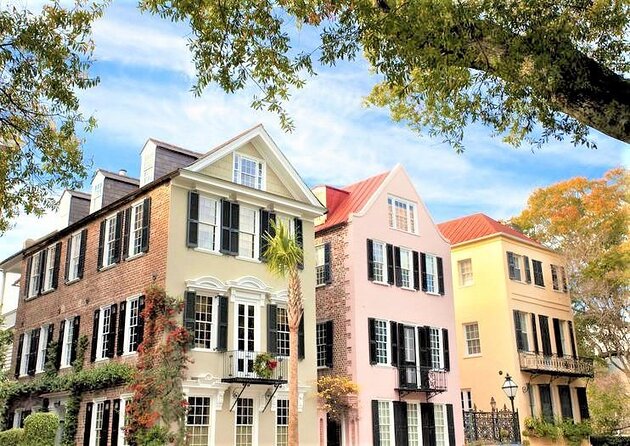
- Big Charleston icons, plus surprises: Rainbow Row, Longitude Lane, the Slave Auction Site Memorial, and more.
- Offline-ready setup: Download with strong Wi-Fi or cellular once, then explore without relying on service.
- Flexible breaks: Pause the tour, go get lunch, then jump back in.
Price and Value: Why $14.99 Can Be a Smart Way to See Charleston

At $14.99 per person, this is priced like a small add-on that can quietly upgrade your whole day. You’re not paying for a guide with a microphone. You’re buying structure, context, and narration so you stop seeing Charleston as just pretty streets and start seeing it as a place with layers.
The value is boosted by two practical things. First, the tour includes audio narration at specific historical sites, not just general commentary. Second, you get lifetime access. That matters in Charleston, where you’ll probably want to return—maybe with different friends, maybe during a different season, maybe when you’re less rushed.
If you’re on a tight schedule, this tour also helps you spend your time well. It nudges you toward the places where the city’s big themes show up: religion, Irish community history, law and government, slavery and its aftershocks, Revolutionary War memory, and the everyday life of a port city.
Trade one set of cobblestones for another with more Charleston walking tours.
- Historic Charleston Guided Sightseeing Walking Tour★ 5.0 · 6,216 reviews
- Charleston Horse-Drawn Carriage Tour: Explore Historic Charleston★ 5.0 · 3,561 reviews
- Ghosts of Charleston Night-Time Walking Tour with Unitarian Church Graveyard★ 4.5 · 2,835 reviews
Offline GPS Setup: The App Experience That Makes or Breaks Your Day
This is a self-guided walk, so the app is the “guide.” The good news: once you set it up, it’s designed to run without cellular service. The tour uses the Action app, and you download the tour while you’re on strong Wi-Fi/cellular.
Here’s what to do before you leave:
- After booking, you’ll receive email/text instructions and a password.
- Download the tour while your connection is strong.
- Once you’re onsite, open Action’s audio tour guide app, enter the password, and start the version that matches your starting point and direction.
During the walk, audio is hands-free. You go to the first story’s point and the narration begins automatically. Then you follow cues to each next stop. If you keep your phone active (no sleep mode), GPS-based cues tend to work more smoothly.
Practical tip: bring headphones/earbuds. Charleston is loud in a nice way—traffic, street life, and people chatting—and audio sounds better when you’re not sharing it with the whole block.
Starting Point and Route: From 152 Market St to the City Market Finish
You start at 152 Market St, Charleston, SC 29401, and you end at Charleston City Market, 188 Meeting St, Charleston, SC 29401. There’s no meeting with a staff member. You’re on your own, following the location prompts.
The walk length is over 2 miles, and the tour is built for about 1 to 2 hours for most people, though it lists an approximate range up to 3 hours depending on how many pauses you take. If you plan to pop into nearby areas, linger for photos, or read signs closely, give yourself that extra buffer.
The route shape matters too. You’ll be moving through downtown clusters—church and civic buildings, historic houses, then the waterfront-adjacent memory sites, and finally the market area. That layout is ideal if you like walking without a lot of backtracking.
Stop 1: Circular Congregational Church and the White Meeting House Story
Your tour begins at Circular Congregational Church, a site with serious staying power. The congregation was established in 1681, when the group was known as the White Meeting House. It began as a meeting place for dissenters who didn’t conform to the Church of England.
What you see today is the result of trouble and rebuilding. The original structure was destroyed by fire, and the circular building you can look at now dates to 1891. This stop is a good reminder that Charleston’s “old” buildings often come with a history of loss, repair, and persistence.
Why it’s worth your time: this is not just architecture porn. The story connects religious conflict, colonial life, and the long timeline that shaped downtown’s identity.
Stop 2 to 3: Hibernian Hall and the South Carolina Historical Society Museum

Next is Hibernian Hall, built in 1840 and tied to the Hibernian Society of Charleston. That society was founded in 1801 by Irish immigrants and their descendants, with the mission of aid, support, and cultural activities.
If you’ve ever wondered how immigrant communities formed their own networks in a port city, this is one of those quiet-but-powerful answers. Charleston wasn’t just one story. It was many groups building institutions.
Then you reach the South Carolina Historical Society Museum. The historical society was founded in 1855 and is one of the oldest historical societies in the U.S. The museum is its main public-facing space, designed to preserve and promote South Carolina’s history.
If you like learning in small chunks, pause here. Even a short visit can give your later stops more meaning, especially when the tour turns to topics that are hard but important.
Go at your own speed with more Charleston self-guided and audio tours.


Four Corners of Law and South Carolina Society Hall: Power at Broad and Meeting
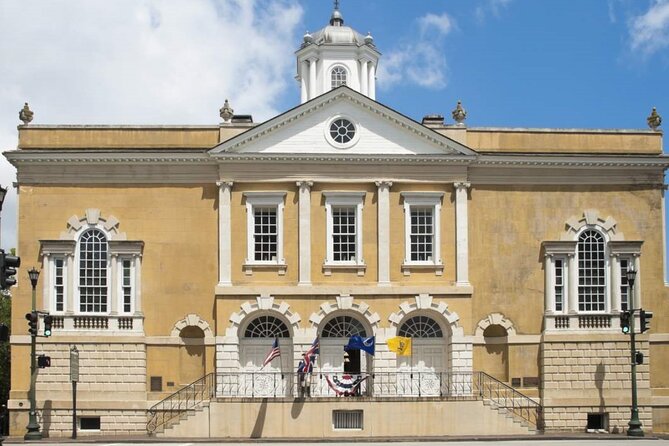
At the Four Corners of Law—the intersection of Broad and Meeting Streets—you get a quick explanation of how Charleston’s government and legal world clustered in one place. The “four corners” idea points to multiple buildings that represented different aspects of law and authority.
This is where the tour shifts from “pretty downtown” into “how the city ran.” If you’re the type who likes to understand why streets are where they are, this segment helps.
Close by is South Carolina Society Hall, also referred to as the South Carolina Society for the Preservation of Spirituals. The building was constructed in 1803 by a social and charitable organization founded in 1737. That organization influenced political, social, and cultural life in Charleston.
This stop is a good example of how a building can carry a whole social mission—long after the people and events are gone.
John Robert Pringle House and the Patrick O’Donnell House Detail You’ll Remember
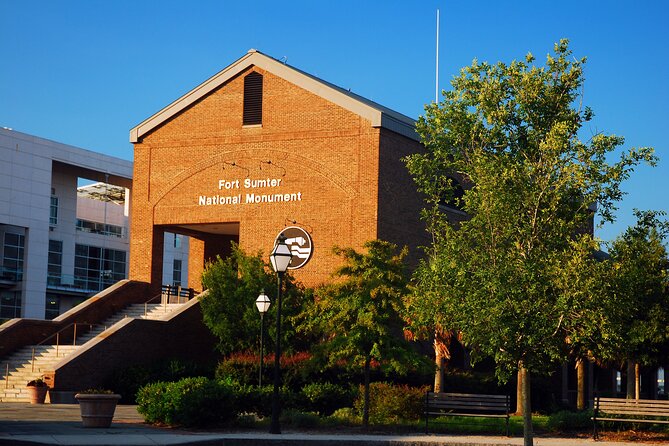
The tour then moves through residential storytelling. First up is the John Robert Pringle House, described as a strong example of life for a European colonist in early Charleston.
Then there’s the Patrick O’Donnell House, noted as the ornate home located two houses down from the Miles Brewton House. The story says it took 12 years to build—because O’Donnell wanted it to be perfect for his fiancée.
Is the house itself the point? It’s part of it. But the more useful takeaway is how personal ambition, wealth, and time shaped the streetscape. Charleston’s beauty isn’t accidental. It was planned, financed, and argued over—sometimes for years.
White Point Garden, Civil War Strategy, and the William Moultrie Memorial

As you move toward White Point Garden, the narration reframes it. The park was originally known as Oyster Point and served as a public gathering place as early as the 18th century. It also had defensive roles during wartime.
Then you get the Civil War angle. Charleston mattered because it had a deepwater port and was a major cotton production and export center. Control of Charleston was vital to both the Confederate and Union forces.
Right near this theme is a monument dedicated to General William Moultrie, tied to the Revolutionary War. Moultrie commanded the fort on Sullivan’s Island, now known as Fort Moultrie, during the Battle of Sullivan’s Island in 1776.
If you want context without getting buried in dates, this segment gives you the “why” before it gives you the “what.”
The Palmer Home and Edmondston-Alston House: Two More Windows Into Downtown Life
You’ll then hit the Palmer Home, built in 1825 for Thomas Bennett Jr., who served as Governor of South Carolina from 1820 to 1822. The house later took on the Palmer name when John Ravenel Palmer purchased it in 1861.
After that comes the Edmondston-Alston House, built in 1825. The narration frames it as a home tied to notable residents and visitors over the years.
These stops are less about one dramatic event and more about continuity. Charleston kept reusing its built environment, passing it between important people, turning private homes into markers of social change.
Longitude Lane and Rainbow Row: Postcard Views With a Useful Story Behind Them
One of the most fun quick stops is Longitude Lane, one of Charleston’s most picturesque alleys. The narration connects it to the cannon story from White Point Garden, noting where a cannon was taken from—giving you a small physical link between different parts of the city’s memory.
Then comes the iconic lineup: Rainbow Row. The houses along Rainbow Row were originally built as mercantile stores and residences for merchants and traders. Over time they were restored and preserved, becoming central to Charleston’s architectural and cultural heritage.
If you’ve seen Rainbow Row in photos but never learned what it used to be, this part helps. It’s not just a “pretty row of houses.” It was built for trade, daily commerce, and the routines of a port city.
Slave Auction Site Memorial and Old Slave Mart Museum: Don’t Skip These Stops
This is where the tour does the hardest work. The Slave Auction Site Memorial marks land tied to slave auctions in the late 1700s and early 1800s. It’s a stark reminder of what was at stake and how slavery shaped Charleston’s economy and social structure.
Then you move to the Old Slave Mart Museum. The narration notes it’s similar to the Old Exchange you may have heard about elsewhere, with some notable differences. This is another stop where the point isn’t comfort. It’s accuracy, acknowledgment, and seeing the city’s past in full.
You’ll probably feel the pace slow here. That’s normal. If you want to absorb it, take a moment. Stand where you are, listen to the audio carefully, and don’t rush to the next photo.
Dock Street Theater, St. Philip’s Church, and the Bent Street Detail
Next you pass Dock Street Theater. The tour notes the building began as a theatre in 1736 and later reopened as a theatre in 1937—with the narration hinting at what happened in between, without you needing to guess.
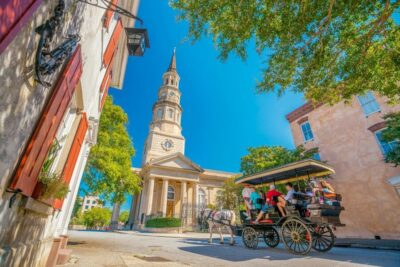
Then comes St. Philip’s Church. You might notice the church juts out onto Church Street. The narration also explains that Church Street bends a little along the church and then straightens again. It’s one of those “wait, that’s weird” details that makes you start noticing how Charleston grew around older choices.
These stops are great for two reasons. First, they show how civic and cultural life changed over time. Second, they train your eye to see the city’s design logic, even when it’s irregular.
Charleston City Market Finish: Food, Crafts, and Gullah Sweetgrass Baskets
You end at Charleston City Market. It’s been here since 1804 and is packed with local arts and crafts. The narration specifically calls out Gullah sweetgrass baskets and tons of delicious food.
This is a strong finish because you can decide how long to stay. If you only want the market as a quick end-point, grab a snack and keep walking. If you want souvenirs, this is the moment to shop without feeling like you’re dragging your day.
One More Thing the Tour Carries: Old Charleston Jail and a Founding Father Connection
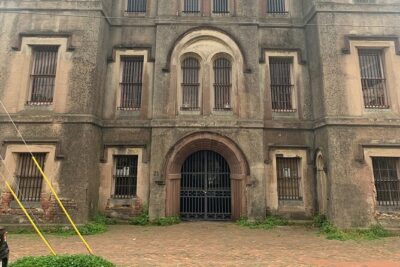
The tour also highlights major nearby story areas like the Old Charleston Jail and a narration tied to the birthplace of one of the nation’s Founding Fathers. Even when you’re just passing by, the audio framing makes those locations feel less random and more connected to the city’s bigger narrative.
If you like “small text” history while walking, this kind of hit-and-run context can be surprisingly powerful. It’s the difference between seeing a building and understanding why it matters.
Who Should Book This Charleston Self-Guided Audio Walking Tour
This works best for you if:
- You want a structured walking plan without a live guide.
- You like learning through narration at the exact moment you’re looking at the landmark.
- You’re okay walking 2+ miles at a relaxed pace with stops.
- You value offline use so your day doesn’t depend on service.
It may be less ideal if you need lots of restroom availability in the first half of the walk. Some people find early gaps in bathroom access. It’s also worth noting that a smooth experience depends on staying near the route so GPS triggers correctly.
If you’re traveling with a partner, it can be good value too. The tour suggests couples can share one tour by splitting headphones.
Should You Book It? My Straight Answer
Book it if you want an affordable, flexible way to understand downtown Charleston while you walk. For $14.99, the lifetime access, the offline GPS audio, and the mix of big-name icons plus deeper site narration are a strong bargain.
Skip it—or be cautious—if you hate depending on phone GPS or if you prefer long, ultra-detailed commentary that never varies. This tour is built for motion and pacing. If your phone sleeps or you wander off-route, audio triggers can get weird.
If you’re the “headphones on, street by street” type, this is one of the easiest ways to turn a casual walk into a day with real meaning.
FAQ
How long is the Charleston self-guided audio walking tour?
It’s listed as about 1 to 3 hours, with guidance that the route is over 2 miles long and often takes roughly 1 to 2 hours to complete.
Where do I start and end the tour?
Start at 152 Market St, Charleston, SC 29401, USA. End at Charleston City Market, 188 Meeting St, Charleston, SC 29401, USA.
Do I need cellular service during the tour?
No. The tour includes offline maps. You must download the tour while you have strong Wi-Fi/cellular, and then it works offline after download.
What language is the narration in?
The tour is offered in English.
Does the audio play automatically based on location?
Yes. After you enter the first story’s point, the audio begins automatically and continues with the next story based on your location.
Is the tour available for future trips?
Yes. It includes new, lifetime access with no expiry, so you can use it anytime on any trip and listen again.
Are admission tickets included for stops?
No. Attraction passes, entry tickets, or reservations are not included.
What do I need on my phone to use the tour?
You’ll need the Action’s Tour Guide App and GPS-capable device support (iPhone iOS 15+ or Android version 9+ are recommended). You should also have headphones/earbuds for best experience.
Is there a live guide with the tour?
No. It’s a self-guided private activity, so no one meets you at the start.
More Charleston Tours Worth Booking






More Self-Guided & Audio Tours in Charleston




More Historic District Walking Tours in Charleston


Still deciding? Here are the newest Charleston tours and experiences we have reviewed









Historic District Walking Tours, compared.
 ★ 5.0Historic Charleston Guided Sightseeing Walking TourFrom $306,216 reviews
 ★ 5.0Charleston Horse-Drawn Carriage Tour: Explore Historic CharlestonFrom $493,561 reviews
 ★ 4.5Ghosts of Charleston Night-Time Walking Tour with Unitarian Church GraveyardFrom $352,835 reviews
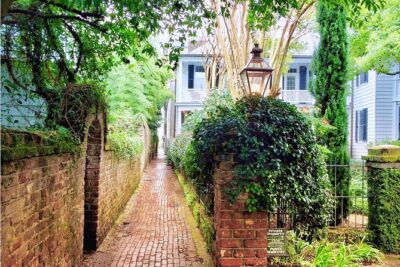 ★ 5.0Hidden Alleyways and Historic Sites Small-Group Walking TourFrom $342,335 reviews
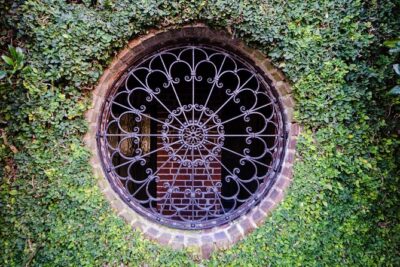 ★ 5.0Highlights of Charleston Guided Walking Tour2,206 reviews
 ★ 5.0Charleston Haunted Booze and Boos Ghost Walking TourFrom $391,569 reviews
 ★ 5.0Charleston’s Pleasing Terrors Night-Time Walking Ghost TourFrom $291,345 reviews
 ★ 5.0Charleston historical walking tour with a Professor of History at The CitadelFrom $401,284 reviews
Browse the lists this tour appears in